Experimental Discovery and Investigation of Transcription Dynamics
Here we list a few foundational experimental works in studying transcriptional mechanisms and stochasticity.
Stochastic gene expression in a single cell - M. Elowitz et al., 2002.
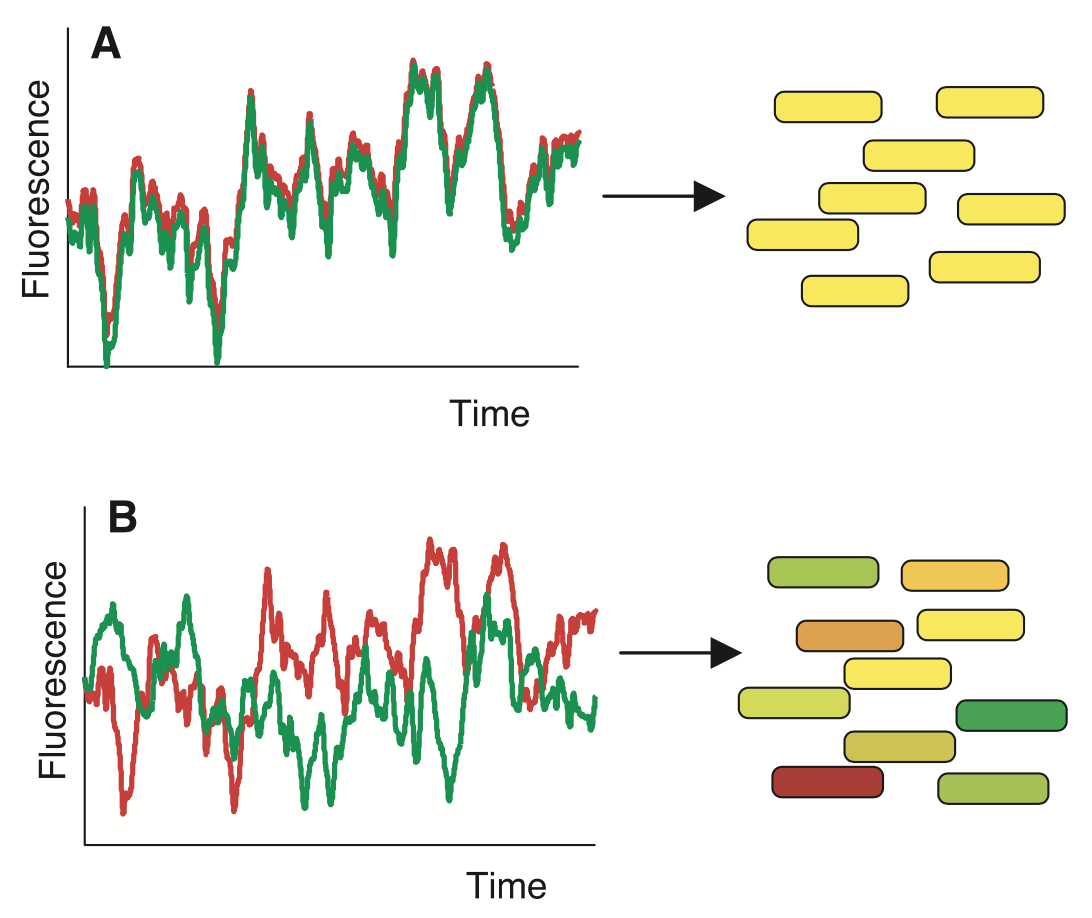
In this article, Elowitz et. al. measured and decomposed intrinsic and extrinsic noise in gene expression. They constructed E coli expressing two fluorescent proteins (cfp and yfp) controlled by identical promoters. The the relative difference in fluorescence intensity of the two reporter proteins in the same cell represents intrinsic noise while the correlated fluctuation of two protein represents extrinsic noise.
Real-time kinetics of gene activity in individual bacteria - I. Golding et al., 2005.
This article measured mRNA levels in individual Escherichia coli cells and demonstrated that transcription occurs in quantal bursts. They also confirmed that the burst sizes are geometrically distributed and the time intervals between bursts are exponentially distributed, which are expected from a two state telegraph model.

Stochastic mRNA Synthesis in Mammalian Cells - A. Raj et al., 2006.
This article measured individual molecules of mRNA produced from a reporter gene and demonstrated transcriptional bursting in mammalian cells.

Stochastic protein expression in individual cells at the single molecule level - L. Cai et al., 2006.
This article developed a live-cell assay system for single-molecule observations. They tested it in Escherichia coli, yeast and mouse embryonic stem cells, and showed that protein molecules are produced in bursts.

Transcriptional burst frequency and burst size are equally modulated across the human genome - R. Dar et al., 2012.
This article used time-lapse fluorescence microscopy to analyze 8,000 individual human genomic loci. They showed that bursty transcription is the major mode for the human genome, and both burst frequency and burst size can be regulated, dependent on the expression level.

Mechanism of Transcriptional Bursting in Bacteria - S. Chong et al., 2014.
This article studied the origin of transcriptional bursting in bacteria using in vitro, single-molecule assay. They showed that active transcription leads to positive supercoiling buildup on a DNA segment which in turns stops transcription initiation, while gyrase binding to the DNA segment can release positive supercoiling and resumed transcription.

Single Mammalian Cells Compensate for Differences in Cellular Volume and DNA Copy Number through Independent Global Transcriptional Mechanisms - O. Padovan-Merhar et al., 2015.
This article studied the effects of cellular volume and DNA copy number on transcription in human cell lines. They showed that transcriptional burst size changes with cell volume and burst frequency changes with cell cycle.

Size-Dependent Increase in RNA Polymerase II Initiation Rates Mediates Gene Expression Scaling with Cell Size - X. Sun et al., 2020.
This article showed that in fission yeast, RNA polymerase II initiation rates linearly scale with cell volume, and constitutive and periodic mRNAs follow a Poisson distribution without transcriptional off states.
